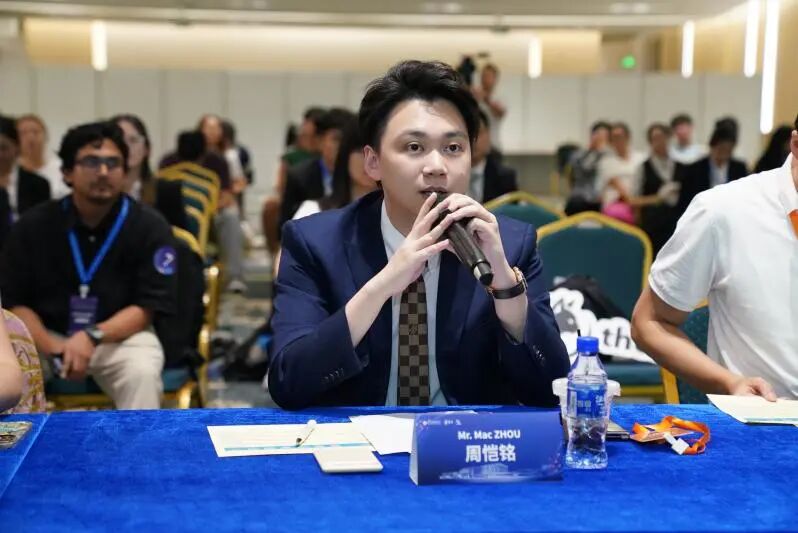
Alumnus, Class of 2012, Finance
Chairman, Jiahe Private Fund
Chairman, Dongni Robot Technology Co., Ltd.
“If I could start over, I would go into finance first. Once I had the capital, I could pursue AI at my own pace.” Having ventured from Silicon Valley investment to AI entrepreneurship and eventually into quantitative asset management, Zhou Kaiming does not regard the twists and turns of his journey as regrets. “Every step counts. Even the detours become part of who you are.” To him, no effort in life ever goes to waste. Every experience eventually becomes part of a unique map of knowledge and insight—and that, he believes, is what gives him the confidence today to move effortlessly between technology and finance.
From BNBU to Critical Thinking: Breaking Free from “One-Size-Fits-All” Thinking
“Critical thinking has benefited me for life.” Even today, Zhou Kaiming vividly remembers his BNBU classroom, where classmates from Hong Kong would raise their hands without hesitation and challenge their professors with questions in English. “When we had just graduated from high school, we had all received almost identical forms of education. At first, I really wasn’t used to it. I thought interrupting the professor would disrupt the class and waste everyone’s time.” Zhou Kaiming recalls the experience with a smile. “It wasn’t until I truly became part of BNBU that I understood what critical thinking meant. It wasn’t about challenging authority; it was about relentlessly pursuing the truth.” He gradually came to realize that questions themselves could be good or bad. “When you hear a genuinely good question, you think to yourself, ‘Why didn’t I think of that?’” This classroom culture of “daring to question, daring to think and daring to express oneself” gradually reshaped the way he approached the world.
During his university years, Zhou Kaiming joined the university’s Enactus team and participated in a community support project for women in Huitong Village, Zhuhai. The women creatively redesigned and repurposed recycled materials into products such as handbags and shopping bags. The student organization helped sell the products, with all proceeds returned to the women. “We weren’t doing this project simply as charity. We wanted to teach them a sustainable business model.” The experience gave Zhou Kaiming his first real insight into a principle that would later shape his approach to business: ventures that benefit more people have greater potential to go further. A good business, he believes, becomes more sustainable and resilient when it creates value for a wider community.
This philosophy has continued to influence his business practices: “You can’t build a business by thinking only about yourself. You have to be willing to share the gains instead of trying to ‘take every last penny.’” Leaving room for the market and business partners, he believes, is essential for building long-term relationships and sustainable growth. “Put something on the table—show your sincerity first. Do everything you can to help the other person and let them see your sincerity and value. When you give first, people are much more willing to give back—and may even feel genuinely grateful.”
His First Taste of Angel Investing: Finding Himself Between Silicon Valley and Chicago
After graduating from university, Zhou Kaiming went to the United States for further study, pursuing finance and entrepreneurship at DePaul University and the University of Chicago.
His decision to choose Chicago, however, was based on far more than university rankings or online reviews. A year before applying to graduate school, Zhou Kaiming did something he describes as rather “bold.” Determined to find the right graduate school for himself, he flew to the United States and spent nearly a month travelling alone across California, Chicago, Boston and New York, visiting more than a dozen universities. Some visits were arranged in advance by email; for others, he simply walked into admissions offices. In the end, Chicago captured his imagination. The city was highly urbanized like Hong Kong, yet less crowded; culturally diverse and architecturally rich. Although located in the American Midwest, it offered an entrepreneurial atmosphere comparable to the West Coast. It was also home to the Chicago Board of Trade (CBOT), one of the birthplaces of modern futures trading. “This was where I wanted to live and study.”
After completing graduate school, Zhou Kaiming joined the wave of angel investing in Silicon Valley in 2015. It was a particularly heated period for global venture capital. Funding in the primary market was abundant, while China’s A-share market was also experiencing a bull run. Investors from China were travelling to the United States in large numbers to search for promising projects, with Silicon Valley, the world’s leading hub for innovative startups, naturally becoming their preferred destination. “A lot of investors would fly over to look at projects, and our job was to host them and connect them with local incubators,” he recalls. Yet after getting a closer look at many of the highly hyped startups, Zhou Kaiming developed a different perspective. “A lot of the projects didn’t seem particularly cutting-edge. Some weren’t even more advanced than what we had in China. Around 90 percent of them were actually quite average.” What surprised him was that many of these projects still managed to secure angel investment. “I remember thinking, ‘Was money really that easy to raise?’”
Zhou Kaiming gained a firsthand understanding of the frenzy surrounding the capital markets at the time, particularly the enthusiasm of Chinese investors. It was during this period that a senior alumnus from the University of Chicago reached out to him. The alumnus had already established a venture capital firm in Beijing focusing on early-stage investments. Taking his senior’s advice, Zhou Kaiming decided to return to China and take on a new challenge.
His First Entrepreneurial Venture: From Chatbots to Intelligent Shopping Assistants
In the autumn of 2015, Zhou Kaiming invited his cousin and the partner serving as CTO to Beijing to discuss the latest developments in artificial intelligence. At the time, AI applications in China were still largely centred on basic conversational chatbots, and the user experience was far from ideal. Zhou Kaiming quickly identified an unmet need in the market: “What many companies really needed wasn’t another generic chatbot. They needed a dedicated customer-service system that could communicate their own brand identity. It had to understand the company’s strengths and be able to tell its story and convey its culture.” The team quickly recognized the enormous potential of the B2B market: developing customized intelligent customer-service systems for businesses.
At the end of 2015, Zhou Kaiming returned to Shenzhen and officially founded Dongni Robot. The company initially launched an online customer-service solution that integrated with platforms such as WeChat and Taobao. However, Chinese businesses at the time were still reluctant to pay for software on a recurring basis, making the business difficult to monetize. “Unless they could buy the software outright and deploy it independently, customers weren’t willing to keep paying. And relying solely on server rental fees was nowhere near enough to cover the high cost of R&D.”
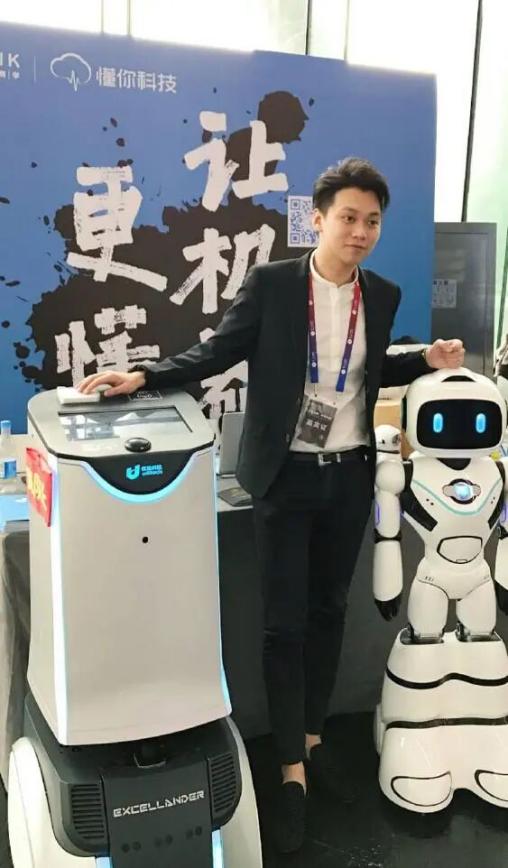
Zhou Kaiming showcasing the company’s robot products at an industry exhibition
The team quickly adjusted its strategy, combining software and hardware and developing physical robots for banks, automobile dealerships and government service center. Their stronger natural-language processing capabilities and customized services won over clients. “One automobile dealership replaced equipment worth around RMB 1 million after adopting our robot.” Users could use natural language to search for vehicle models and configurations and even compare prices. The robots could not only provide accurate answers but also recommend options based on users’ needs. Yet the company continued to face challenges in market expansion. Franchise stores were reluctant to make additional investments, while competition for AI talent in Shenzhen was intense and labour costs were high. “A fresh graduate in engineering could cost more than RMB 20,000 a month. Almost all of our revenue went towards salaries.”
A turning point came in 2019, when the team reached an agreement with Poly Group to develop a comprehensive intelligent navigation system for shopping malls. The system could connect to merchants’ backend databases, enabling natural-language product searches and three-dimensional navigation. “For example, you might say, ‘I’m looking for something that can clip onto a desk and hold up my phone.’ Even if you didn’t know it was called a ‘phone stand,’ the system could identify what you meant and tell you which store had it and how to get there.”
The team poured enormous effort into the project, spending more than six months developing most of the system. However, just as they were about to enter business negotiations, the COVID-19 pandemic broke out in 2020. The business world came to a standstill, and the partnership came to an abrupt end. “They suddenly told us that the entire shopping mall was going to be sold. All our work went back to zero overnight.” Even now, Zhou Kaiming finds it difficult to hide his disappointment when recalling the episode. Yet this unexpected setback would become a major turning point in his transition across industries.
The Shift to Quantitative Finance: From AI Idealism to Financial Realism
The pandemic brought the company’s core business to a standstill, leaving Zhou Kaiming deeply frustrated. “We were the service provider and they were the client, so we didn’t have much bargaining power to begin with. More importantly, shopping malls across the country were largely closed at the time. No one was thinking about intelligent transformation.” As the team struggled to find a way forward, a field they had encountered almost by chance returned to their attention.
They had previously taken on an outsourced project to develop a cryptocurrency market-data application for an overseas client. The team built a tool-based app combining market data, news updates and intelligent alerts. “When we studied products across different platforms, we found that even basic indicators such as MACD and RSI were calculated and presented differently. The more advanced trading-assistance features varied even more. There were arbitrage opportunities across different financial markets.” This led the team to explore the potential applications of algorithms in finance. They began experimenting with various trading-assistance functions, including AI-based predictions of potential buying and selling points. “At that point, we had a feeling that quantitative trading was worth exploring.” The pause brought about by the pandemic unexpectedly gave the team an opportunity to conduct deeper research. After retaining their core engineers, the team devoted itself fully to quantitative strategy research. They discovered that the structure of futures markets and the high volatility of commodities made them naturally suited to quantitative trading models.
In the second half of 2020, through a friend’s introduction, Zhou Kaiming’s team entered into a partnership with Jiahe Private Fund, established a new ownership structure and made a full transition into quantitative asset management. “We didn’t completely abandon the original AI business, but we stopped developing new products. Without cash flow, there was no way to keep iterating on the technology.”
Today, Jiahe Private Fund has expanded its strategies from commodity futures to options, individual equities and enhanced-index strategies, while its team has continued to grow. Looking back on the transition, Zhou Kaiming reflects: “When I was doing AI, I always carried the ideal of using technology to change the world. But the reality was that R&D consumed a lot of money and commercialization was difficult. In quantitative finance, capital can circulate much more efficiently. Once a strategy proves effective, it can create a positive cycle.” He does not see the transition as giving up on his ideals. Instead, he sees it as a more pragmatic path: “First, build the ability to generate your own cash flow. Then pursue your technological dreams.” Using High-Flyer Quant as an example, he further reflects: “If I could do it again, I might start with finance and then move into AI. When you get the order wrong, the outcome can be completely different.” For Zhou Kaiming, strategic caution matters far more than simply working harder at the tactical level. This applies not only to entrepreneurship, but also to life.
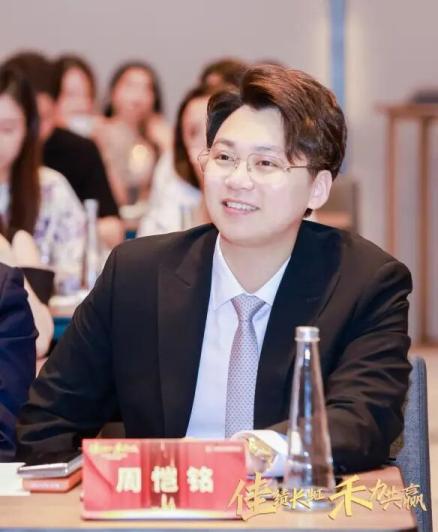
Zhou Kaiming at a Jiahe Private Fund meeting
The Essence of Cross-Disciplinary Thinking: Lifelong Learning and Playing to Your Strengths
Zhou Kaiming’s ability to move across industries did not come naturally. As he candidly admits: “To be honest, it was only after I entered the financial industry that I realized how little I actually knew about it. I had studied my finance courses seriously, but after leaving university, I realized that the financial system in the real world doesn’t work like that.” His learning journey has been driven by continuous practice and questioning. He accumulated his AI knowledge gradually through countless discussions with his CTO, industry conferences and conversations with people in the field. His understanding of quantitative trading emerged from questions such as: “Why are the algorithms used by platforms like Tonghuashun and East Money different?”
For Zhou Kaiming, learning through practice is particularly valuable. “The most effective learning begins when you know what you need to learn. A client forces you to understand their needs. A supplier requires you to figure something out. A specific problem raised by a customer pushes you to go into the field, observe and verify.” His advice to young people is therefore straightforward: “Especially in the age of artificial intelligence, don’t blindly try to make up for every weakness. Make your strengths strong enough—strong enough that AI cannot replace them. That is how you establish your place in society.”
When asked to describe his experience at BNBU, Zhou Kaiming immediately responds in English: “Critical Thinking, Imagination, Entrepreneurship—these three words represent the greatest things I gained from BNBU.” He says the three words seem to capture more precisely what that period of his life meant to him. “Not because they sound cool, but because they genuinely changed me.”
What BNBU gave Zhou Kaiming went beyond critical thinking and the courage to turn ideas into action. It also gave him the confidence to keep learning, embrace change and take on new challenges. Every experience counts. No road is ever truly wasted.
(Written by Gao Keyang, Class of 2024, Master of Taught Media Management, BNBU)
【Company Introduction】
Jiahe Private Fund
Established in 2016 and headquartered in Shenzhen, Jiahe Private Fund is a quantitative investment institution driven by artificial intelligence.
The company focuses on the research and development of multi-strategy quantitative models and asset management across commodity futures, options, equities and other financial products. It is committed to empowering finance through technology and delivering stable returns for investors.
Industry: FinTech / Quantitative Investment
Location: Shenzhen, Guangdong, China
Alumni Entrepreneurship Stories
Share Your Story with BNBU
Your story. Your alma mater remembers.
No matter where life takes you, your time at BNBU remains a shared treasure.
We look forward to hearing your unique memories and entrepreneurial journey.
To be interviewed, please contact: ic@bnbu.edu.cn